
Milton Keynes shone brightly this September with its inaugural MK Tech Week, a five-day celebration of innovation, connectivity, and the city’s growing influence in the UK technology ecosystem.
From robotics and artificial intelligence to smart cities, education and investment, the programme demonstrated how Milton Keynes is positioning itself as a serious player in national tech conversations.
The week began with a VIP reception at Bletchley Park, linking the city’s historic role in codebreaking to its future ambitions in AI and digital infrastructure. Events followed across venues including the MK:U Innovation Hub, Unity Place, the Open University, and centre:MK. With more than 2,400 tech firms and strong institutional anchors such as the Open University and Cranfield, the organisers sought to create not just a showcase but a hub where talent, investors and innovators could form lasting ties.
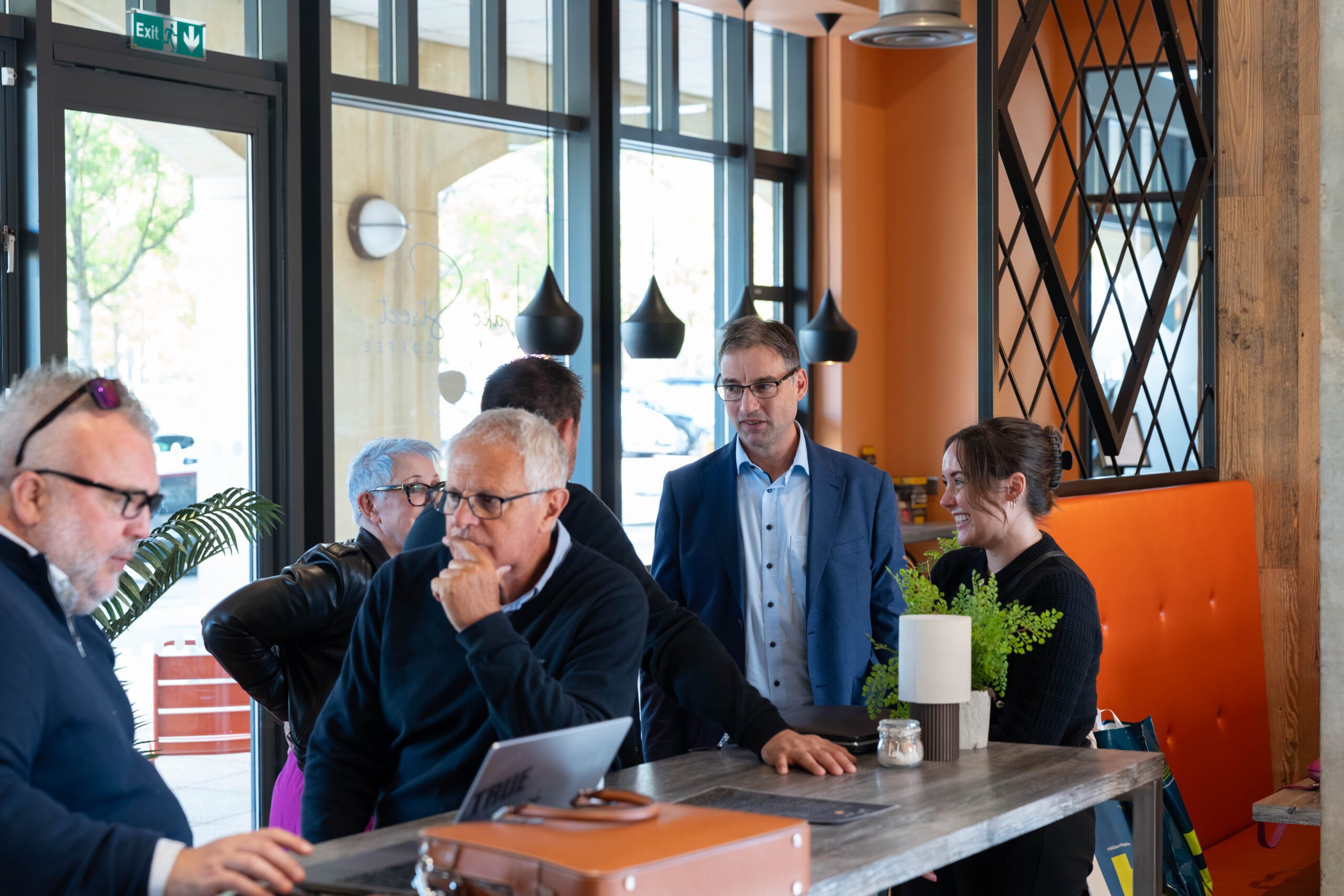
Among the week’s notable successes was The Founders Lounge, hosted by Central Arc Angels. Designed as a relaxed environment for early-stage founders, it encouraged open mentoring and investor networking without the pressure of a formal pitch. This inclusive setting reflected Central Arc Angels’ mission to connect entrepreneurs with funding opportunities and strengthened the informal networks that form the backbone of a startup ecosystem. Having such a vested interest in local business, they specifically chose a central independent coffee shop to host the event, which acted as the ideal collaborative setting.
The Lounge coincided with sessions on responsible AI and online safety, notably Building Safer Digital Futures: Tech to Protect Women Online, held at the Open University. Pairing a founder networking space with a conversation on ethical innovation reinforced the message that technological progress must also prioritise responsibility and inclusion.
Across the broader schedule, several panels drew strong attention in both the press and social media. The AI Summit, featuring speakers from Microsoft, Google and innovative SMEs, was a highlight. Its focus on practical adoption over abstract theory – how smaller organisations can integrate AI responsibly, manage data risk and build governance frameworks – earned praise for substance over hype.

The Building Safer Digital Futures session resonated widely, uniting legal scholars, technologists and community advocates to address online harm, algorithmic bias and accountability. The debate was passionate and reflective, positioning technology’s social impact as a defining challenge for the industry. Its connection to the Open University’s £7.7m initiative to protect women online gave it further significance.
Meanwhile, the Smart City Robotics demonstrations at centre:MK brought innovation into public view. University teams and start-ups showcased drones and warehouse automation as well as assistive robotics, translating complex ideas into tangible experiences for families and students. It offered a glimpse of how research and urban life can intersect in practical, engaging ways.
Education featured prominently through the Future of Adult & Lifelong Learning in the Age of AI conference hosted by the Open University and Infosys. The discussion explored how AI is reshaping skills and credentials, particularly for adults transitioning between industries. Topics like algorithmic tutoring and the importance of continuous learning connected the region’s academic heritage with its digital ambitions.
The week closed with a live pitch event at Unity Place, where local start-ups presented to investors and business leaders. Beyond capital, these founders sought credibility and belonging within an emerging ecosystem. Supporting sessions on funding and scaling grounded the optimism of the week in practical guidance for sustainable growth.
Reflecting on MK Tech Week as a whole, what stood out was its balance between spectacle and substance. The mix of robotics showcases and funding workshops gave the programme both excitement and depth. The Founders Lounge exemplified this balance. Not flashy, but essential. It provided the connective tissue that ensures conversations extend beyond the event itself.
Equally striking was the organisers’ commitment to inclusion and ethics, and, crucially, digital responsibility. By placing responsible AI and online safety at the centre of the programme, they signalled that Milton Keynes aims to be known not only for innovation but for integrity. This distinguished MK Tech Week from more commercially driven regional festivals.
Challenges remain, particularly around funding access for early-stage companies and sustaining momentum beyond the event. Several investors observed that while ideas and enthusiasm abound, consistent follow-through and structured capital pathways will determine whether Milton Keynes can transform this energy into a durable tech ecosystem. Initiatives like The Founders Lounge and Central Arc Angels’ ongoing work will be crucial in bridging that gap.
MK Tech Week set out to unite people, ideas and ambition under one banner. It showcased the region’s talent and celebrated its academic and industrial strengths while fostering collaboration. Yet perhaps its most enduring success lies in the quieter spaces, in the mentoring moments, the introductions over coffee, the spontaneous conversations that spark innovation. If those connections are nurtured, Milton Keynes could evolve from an emergent hub into one of the UK’s defining centres for digital innovation.
To find out more, visit their website.