
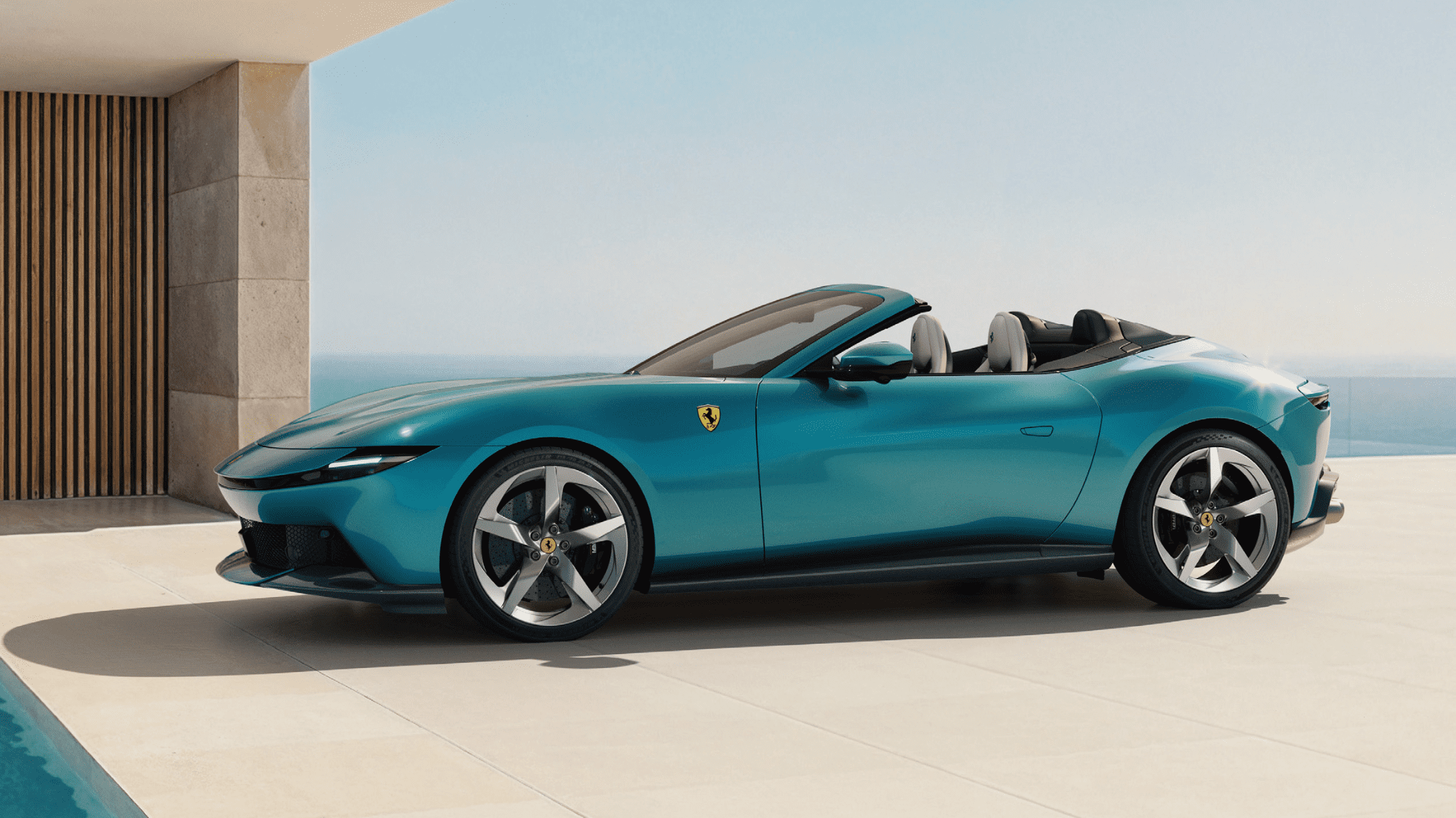
Ferrari has unveiled the new Amalfi Spider: a V8 2+ Spider with a front-mid-mounted engine that embodies the perfect balance between contemporary sportiness and versatility within the Ferrari range.
Designed for those who want a more dynamic driving experience without compromising comfort or style, the Ferrari Amalfi Spider combines outstanding performance and everyday versatility with the unique pleasure of open-top motoring, making every journey more engaging.
The car exemplifies the Ferrari sporting lifestyle in an open-top configuration: a seamless blend of performance, elegance, driving pleasure, ease of use and versatility. With the roof down, direct contact with the road and the sensations of open-air driving become integral to the experience, without compromising everyday usability or comfort.
The design of the Spider was driven by the desire to preserve the proportions and volumes of the Ferrari Amalfi , retaining its elegant, flowing silhouette even with the roof open. The soft top, a choice that enhances the car’s versatile character by giving it a clear and distinctive position within the range, adds a more expressive character through a wide range of personalisation options, with four colours in tailor-made fabric and two in technical fabric, including the new Tecnico Ottanio. Optional contrast stitching further underscores both the car’s sporting character and its refined elegance. The distinctive weave of the technical fabric also creates a shimmering effect that enhances the material’s three-dimensionality.
The soft top opens in 13.5 seconds and can be operated on the move at speeds of up to 60 km/h. When folded, its compact packaging – just 220 mm thick – maximises luggage capacity, offering 255 litres with the roof closed and 172 litres with the roof open, in a layout suited to both everyday use and weekend getaways.
Acoustic and thermal insulation is provided by a five-layer fabric delivering soundproofing and heat insulation comparable to that of a Ferrari retractable hard top, allowing occupants to appreciate the quality of the soft-top material even when driving with the roof down.
Like the Ferrari Amalfi, the cabin features a dual-cockpit layout and an evolved driver–car interface. Key elements include the steering wheel with physical buttons, the return of the iconic start button, the integrated central display, and controls designed for natural interaction even during the most dynamic driving. The 2+ configuration enhances practicality, with rear seats suitable for travelling with children or increasing load capacity. Completing the experience, an integrated wind deflector built into the rear bench backrest, and operated at the touch of a button, improves comfort by reducing turbulence during open-top driving.
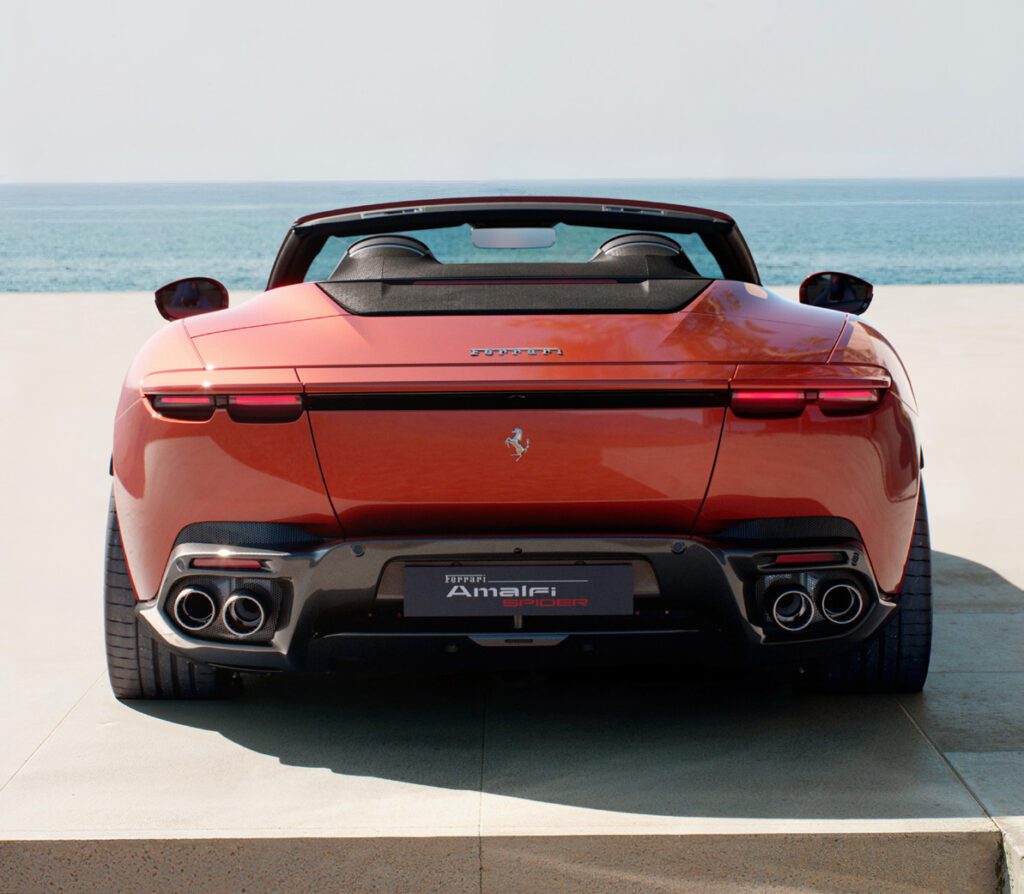
The car’s design is based on a fluid, minimalist approach, with sculpted volumes and clean surfaces that convey modernity and dynamism. The front end is defined by a large air intake and a long, sculpted bonnet that houses the 640 hp turbocharged V8. At the rear, the integrated active spoiler contributes to high-speed stability, while forged wheels and carbon fibre details complete a sporty and sophisticated aesthetic.

On the outside
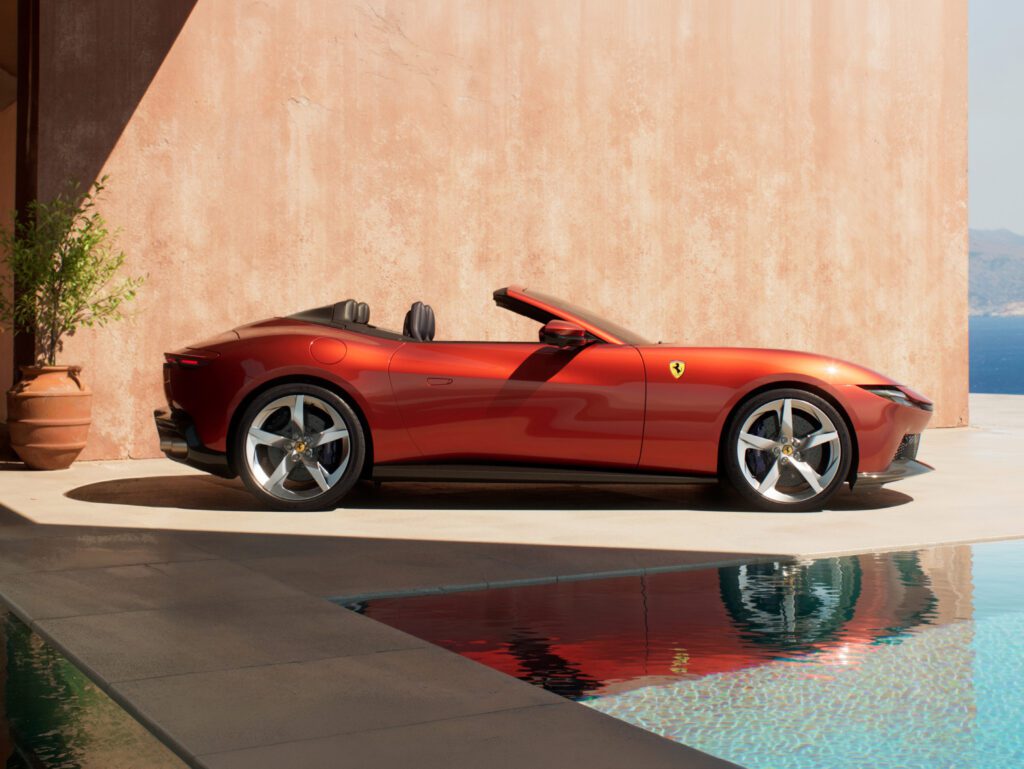
The silhouette is elegant, fl uid and instantly recognisable, whether the roof is open or closed. The design language blends refinement and energy, taking shape as a monolithic, sleek and sculptural speedform that gives the car a modern, fresh character while retaining unrivalled elegance. The approach is minimalist and functional, built around a precise interplay of volumes and clean surfaces sculpted by light.
With the Ferrari Amalfi Spider, Ferrari introduces the new Rosso Tramonto colour, an exclusive shade that enriches the chromatic journey begun with Verde Costiera, inspired by the hues of the Amalfi Coast. The signature colour of the Ferrari Amalfi Spider takes shape at the evocative boundary between sea and sky at dusk, embodying the character and distinctive elegance of the landscape that inspired it. Th is new shade, intense yet refined, is distinguished by subtle orange undertones that evoke the warm light of the setting sun, igniting the coast’s most iconic vistas.
On the inside
The interior design is deliberately clean, minimalist and contemporary, shaped by a process of subtraction that highlights materials, surfaces and geometries. For the first time, the instrument cluster and air vents are brought together within a single monolithic cock-pit, evenly divided between driver and passenger. The central tunnel adopts a pure, essential form: a suspended bridge machined from solid aluminium houses the primary controls, while secondary functions are positioned further back to improve ergonomics and clean visuals. The door panels introduce a sail motif – sculptural elements that integrate the handles and armrests. Personalisation also extends to the interior, with selected components trimmed in the same fabric as the soft top, including the tonneau cover, door panels and seatbacks, creating an unprecedented stylistic continuity between exterior and cockpit even with the roof stowed.
The new steering wheel, featuring physical buttons, marks a return to tactile controls, with a layout engineered to ensure maximum ergonomics and immediate recognisability in all driving conditions. The return of the iconic anodised aluminium start button establishes an immediate bond between driver and car from the very first moment of start-up. The controls are functionally distributed: on the left spoke are the ADAS controls, adaptive cruise control, phone, and voice commands, while on the right are the selectors for visualisation and interaction with the instrument panel. At the rear, two rotary dials manage volume and station selection, while a dedicated button is used to switch audio sources.
A series of functional devices are incorporated into the car, which contribute to flow management and help to balance load and resistance. At the front, a bypass above the headlight connects the front end of the car to the engine compartment, reducing overpressure and contributing to thermal control; vertical load generation is enhanced by the vortex generators and diff users integrated into the front underbody of the car, while in front of both the front and rear wheels, the vehicle is equipped with aerodynamic and resistance-reducing fairings for the exposed part of the wheels.
Particular attention has been paid to passenger comfort when the roof is open. The Ferrari Amalfi Spider is equipped with a wind deflector integrated into the backs of the rear seats, which can be activated by the driver at the touch of a button without needing to stop. When the configuration is active, the airflow that would enter the cockpit of the car from the rear is deflected, creating a more stable bubble of comfort around the passengers and reducing turbulence and noise, particularly in the head area.
On the road
The engine of the Ferrari Amalfi Spider, like that of the Ferrari Amalfi, represents the latest evolution of the 3855-cc V8 twin-turbo from the F154 family – the model that has won the most awards in recent automotive history. In this configuration, the engine has been optimised to deliver a maximum output of 640 hp at 7,500 rpm, with a specific power output of 166 hp/l and a redline raised to 7,600 rpm, allowing it to get the most out of its continuously increasing power curve.
The performance increase compared to the Ferrari Roma Spider was achieved through an advanced turbocharging management system, enabling independent control of the rotational speed of the two turbochargers with dedicated calibration and an increase in the maximum turbo speed up to 171,000 rpm.
In parallel, efforts were made to reduce mass: new lightweight camshafts and a redesigned engine block with precision machining eliminated non-structural material, saving about one kilogram. For the first time in a Ferrari engine, a low-viscosity oil has been introduced, reducing cold resistance by 30% compared to the previous version, improving warm-up efficiency.
Throttle response is now even quicker thanks to a series of advanced technical solutions: a flat-plane crankshaft, compact low-inertia turbines, twin-scroll technology for separate exhaust gas management, and a single-scroll manifold with equal-length runners. These elements contribute to a sensation of continuous and progressive power delivery, with a torque curve shaped to provide stronger pull at mid and high revs in all gears.
The choice of tyres for the Ferrari Amalfi Spider was guided by a careful balance between aesthetics, performance and comfort. The 20” wheels were selected to maintain the harmonious proportions consistent with the car’s design language, without compromising ride quality. To ensure maximum comfort, the sidewall aspect ratio chosen for the Ferrari Amalfi has been retained, ensuring a progressive response and good absorption of road surface imperfections.
Visit the Ferrari website to find out more.