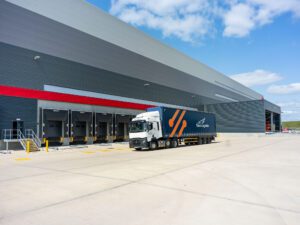


Stand at DIRFT, drive through Pineham or Brackmills, or follow the A5 and M1 routes between Northampton and Milton Keynes, and it is obvious why this part of the country matters so much to UK logistics.
Northamptonshire sits at the heart of the Golden Triangle, and Milton Keynes is a key node on the same distribution network, with fast access to national road links and major consumer markets. This is not just another business corridor; it is a market where workforce gaps can quickly become operational problems, with consequences for service levels, delivery performance and customer relationships.
For many warehousing and distribution businesses, immigration has never really been a broad answer to labour demand. Where sponsorship has featured, it has tended to sit within a narrower band of management and specialist roles, rather than as a solution to labour pressure across an entire site. What has changed since July 22, 2025 is that even this narrower route has tightened.

That matters because some of the roles logistics businesses could once more readily consider for new sponsorship no longer sit in the same position. The current Skilled Worker framework is more heavily weighted towards higher-skilled roles, while a number of medium-skilled occupations now sit outside the main route for new applicants unless they fall within the Temporary Shortage List. Some other roles are preserved only through transitional arrangements for workers already in the route.
In practical terms, that means parts of the sponsorship toolkit this sector may have quietly relied on in the past are no longer available in the same way. Managers in storage and warehousing are a good example; so too are managers and directors in retail and wholesale. Some roles remain available, including managers in logistics through the Temporary Shortage List and certain roles that qualify at the higher skill level in their own right, but the overall picture is one of contraction.

Here is the irony: just as that traditional route is narrowing, the sector’s own evolution is quietly opening a different door, and many operators may not yet be treating it as part of their immigration planning.
As warehousing and distribution becomes more automated, more data-led and more dependent on systems integration, the shape of the sector’s talent challenge is shifting with it. According to UKWA’s Skills Survey 2025, over half of warehousing employers anticipate critical skills shortages in automation and robotics within five years. For the largest operators, this has been part of the picture for some time. But for many mid- sized businesses, regional distributors and growing 3PLs, the pace of change now feels far more immediate.
Warehouse management systems are becoming more sophisticated, automation more commercially accessible, and data more central to inventory planning and operational decision making. Businesses investing in this infrastructure across the Milton Keynes and Northamptonshire logistics market are discovering something that has not featured in their immigration planning: these investments require highly specialised people to deliver them, and those people can be difficult to source domestically.
Consider what it takes to implement a modern automated warehouse. Someone needs to integrate the warehouse management platform with the robotics orchestration layer, a role that has become far more visible in mid-market logistics in recent years. Someone needs to build demand-forecasting models and configure AI-driven replenishment logic. Someone needs to translate what the operation requires into what the system does, the kind of business systems analyst role increasingly central to whether a capital-intensive automation project delivers its promised returns. These are not peripheral appointments; they are the roles that determine whether the investment works.
That creates a different kind of immigration question. It is no longer simply whether sponsorship can help fill management gaps; it is whether a business investing in transformation and automation has considered that some of the roles needed to make that investment work may still be sponsorable.

Depending on how a role is structured and coded, positions in data analysis, systems analysis and technology functions may fall within eligible occupation categories. Roles available through the Temporary Shortage List carry certain restrictions, including limitations on bringing dependants, and the interim position for below-RQF-6 roles is time-limited while the Migration Advisory Committee’s review continues. Eligibility always turns on the actual duties, seniority and salary, not simply the label attached to the job. But for a business finding the right people difficult to source domestically, the sponsorship route is worth examining carefully.
There is also a timing point that businesses entering this territory for the first time should not underestimate. Many warehousing and distribution businesses have never held a sponsor licence, and being ready to sponsor is not just about obtaining a licence when a need arises. It is about understanding the compliance burden, identifying genuinely eligible roles, coding them correctly, and ensuring right-to-work processes are robust enough when a critical hire becomes urgent.
In a high-throughput, multi-shift environment, discovering that the process takes longer than expected at the moment a key implementation role cannot be filled is an avoidable problem.
The immigration conversation for logistics and warehousing is shifting in a more specific way than is sometimes acknowledged. Some of the roles businesses could once reach through sponsorship are no longer available in the same way. At the same time, the sector’s growing reliance on systems, data and automation may be creating a different, and still underexplored, opportunity, one that may become increasingly relevant as automation plays a larger role in logistics operations and domestic supply does not always keep pace with demand.
The businesses most likely to navigate the next few years well will be the ones that understand both sides: where sponsorship no longer reaches in the way it once did, and where the changing shape of their own operations may be opening doors they have not yet thought to try.
By Bilal Ehsan, Immigration Solicitor at Howes Percival
For advice contact Bilal Ehsan at bilal.ehsan@howespercival.com or Immigration Adviser Bineeta Joshi at bineeta.joshi@howespercival.com
Find out more about Howes Percival on their website.