
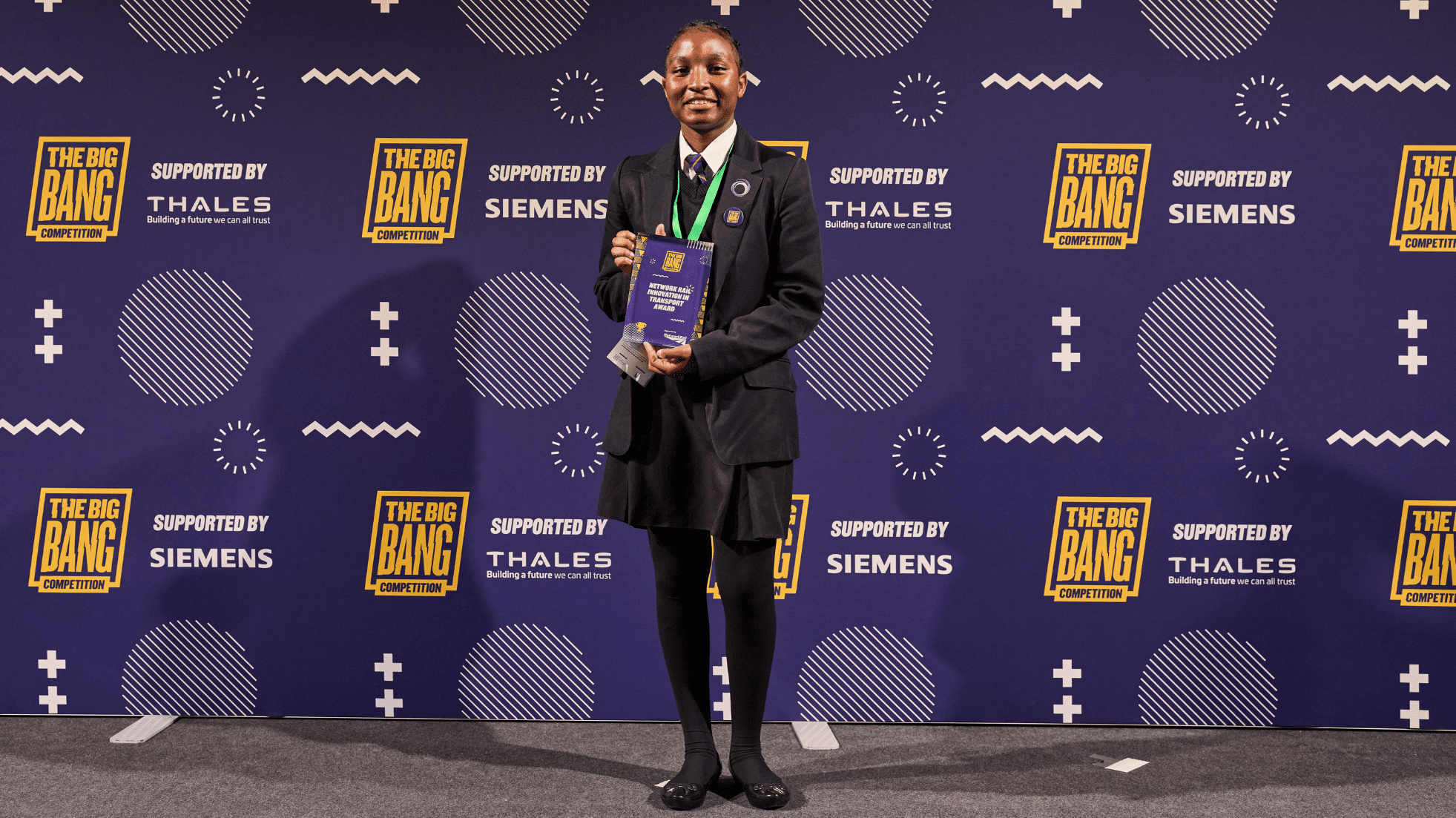
A student from the South East has scooped an award in The Big Bang Competition, a prestigious nationwide competition for young engineers, scientists and technologists, with 8 more announced as runners-up.
Marcel Fabicki, a year 12 student at Cobham Free School, won the London International Youth Science Forum 2026 for his project ‘AURION – the jungle pinball machine’. Marcel was also named runner-up for the Senior Engineering award. They impressed the judges by building a full-size working pinball machine using mostly recycled and salvaged materials. With the aim of creating an arcade machine that was more accessible, Marcel successfully demonstrated how complex systems can be built from simpler, understandable parts.
Richard Myhill, Executive Director at London International Youth Science Forum (LIYSF) commented: “Congratulations to Marcel! The standard of projects was extremely high, and we were very impressed by both the creativity and technical quality of the work presented. Marcel’s project stood out for its strong combination of engineering and software approaches, alongside a clear, logical approach to problem solving. Their enthusiasm, communication skills, and confidence in presenting the work were also particularly impressive. LIYSF is proud to support The Big Bang Competition because it celebrates exactly the kind of curiosity, innovation, and passion for STEM that we aim to encourage through our international science programme.”
Advik Gupta, Arnav Tayal and Vedant Venkat, year 9 students at from Upton Court Grammar School were runners-up for the Junior Science award with their project ‘De extinction using bioengineering and biotechnology techniques’. They examined the potential of modern genetic engineering to bring extinct species back to life. Motivated by rapid advances in DNA technology and growing interest in conservation science, the research evaluates both the scientific feasibility and ethical implications of de-extinction. Their project highlights that while the science shows exciting promise, significant moral and environmental considerations remain.

Sophia Assimakopoulos and Srinika Sabarirajan, both year 9 students from Invicta Grammar School were runners-up for the Junior Science award for their project ‘How can enzymes help end plastic pollution?’. They explored how naturally occurring enzymes could offer a breakthrough in tackling global plastic pollution. Inspired by the urgent environmental crisis affecting oceans, early findings suggest their solutions could provide a promising approach to reducing long-lasting plastic waste.
Emily Moore and Libby Miles, year 12 students also from Invicta Grammar School were runners-up for the Senior Science award with their project ‘Adapting red light for skin repair’. They teamed up to assess the potential of red light therapy as a non-invasive treatment for skin repair for children with neurodevelopmental conditions. Their results indicate that red light therapy may support skin recovery, offering a promising direction for future medical treatments.
Pranav Anand Senthil Anand, a year 7 student from Reading School was runner-up for the Junior Technology award with their ‘DriveSafe: AI safety assistant’ project. They created an AI-based traffic light system that improves road safety. Prompted by concerns over accidents caused by drowsy and distracted driving, their system uses AI to monitor and respond to road conditions in real time.
Dr Hilary Leevers, Chief Executive of EngineeringUK who run The Competition said: “Massive congratulations to Marcel, Advik, Arnav, Emily, Libby, Marcel, Pranav Anand, Sophia, Srinika, and Vedant. Their curiosity and creativity have driven them to produce some brilliant STEM projects addressing some really big societal problems. They should all be very proud of their dedication and hard work. Competitions like The Big Bang Competition help young people connect their passions with making a real-world difference, it shows young people a future in engineering and technology is possible for them.”
The winners of The Competition, which recognises and rewards talented young innovators, were announced at an awards ceremony at The Big Bang Fair. The Fair is the UK’s largest celebration of science, technology, engineering and maths (STEM) for young people held at Birmingham’s NEC over 9 June to 11 June.
To find out more and discover all the winners and runners-up of The Big Bang Competition 2026, or to find out more about The Big Bang Far visit The Big Bang website.